NutriMill vs WonderMill Comparison: Which Grain Mill Is Best for Homemade Flour?

on Oct 20, 2012, Updated Feb 11, 2026
This post may contain affiliate links. Please read our disclosure policy.
Nutrimill vs Wondermill: I’ve been using grain mills for more than 20 years. Here are benefits and drawbacks of the two models I’ve used the most and why I’m considering a KoMo mill.
I started with the NutriMill. Years later, I received a WonderMill for participating in a blog challenge. Then the emails started.
“Which grain mill should I buy?”
“Is the NutriMill better than the WonderMill?”
“Do they really perform differently?”
That’s why I wrote this comparison. After testing both in my own kitchen, baking countless loaves of bread, and grinding flour weekly for my family, I eventually kept the NutriMill and sold the WonderMill. Here’s exactly why.
Table of Contents
- Quick Overview: NutriMill vs WonderMill Grain Mills
- What NutriMill and WonderMill Have in Common
- NutriMill vs WonderMill: The Key Differences That Actually Matter
- Real-Life Performance: What I’ve Learned Using Both Mills
- Which Grain Mill Is Best for Sourdough Bread?
- NutriMill vs WonderMill Price Comparison
- A Third Option: The KoMo Mill
- My Final Recommendation: Which Grain Mill Should You Buy?
- Is Grinding Your Own Flour Actually Worth It?
- Frequently Asked Questions About NutriMill and WonderMill
Quick Overview: NutriMill vs WonderMill Grain Mills
Here’s what you need to know right off the bat:
- Best for large batches: NutriMill
- Best for smaller kitchens: WonderMill
- Flour texture: Both grind incredibly fine
- Noise level: Both are loud (I’m not going to lie to you)
- Ease of use: Both are simple to operate
- Bottom line: Choose based on how much you bake and your kitchen space

What NutriMill and WonderMill Have in Common
Before I get into the differences, let’s talk about what these grain mills share.
Both machines:
- Grind dry grains into very fine flour
- Handle wheat, spelt, rye, oats, and other hard grains
- Use high-speed impact milling technology
- Produce fresh flour in under a minute
- Are straightforward to operate with no complicated setup
I’ve used both mills. They’re both powerful. They both make excellent flour. If you want soft, fluffy whole wheat bread, either machine will get you there.
NutriMill vs WonderMill: The Key Differences That Actually Matter
Now let’s get into what sets these two grain mills apart in real daily use.
Grain and Flour Capacity Comparison
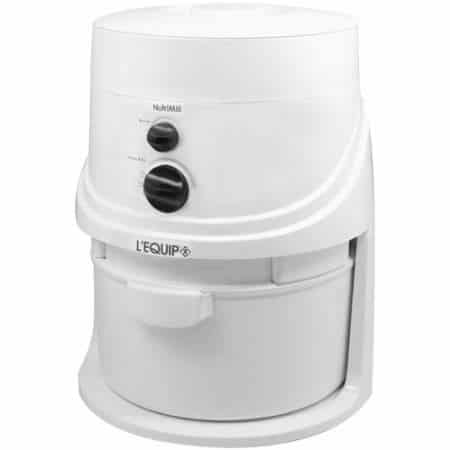
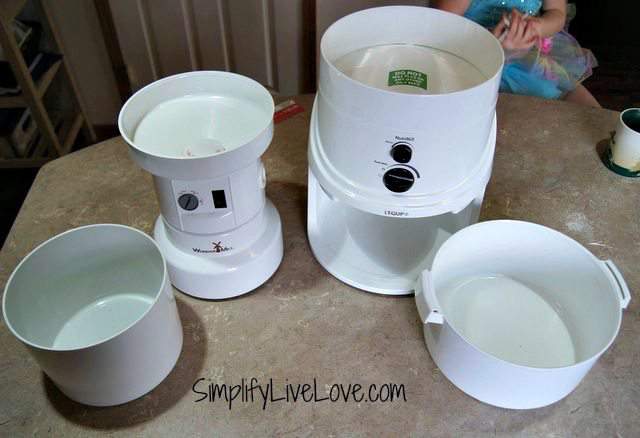
NutriMill: This beast holds up to 20 cups of grain. The flour collects in a large attached bowl that’s built right into the unit.
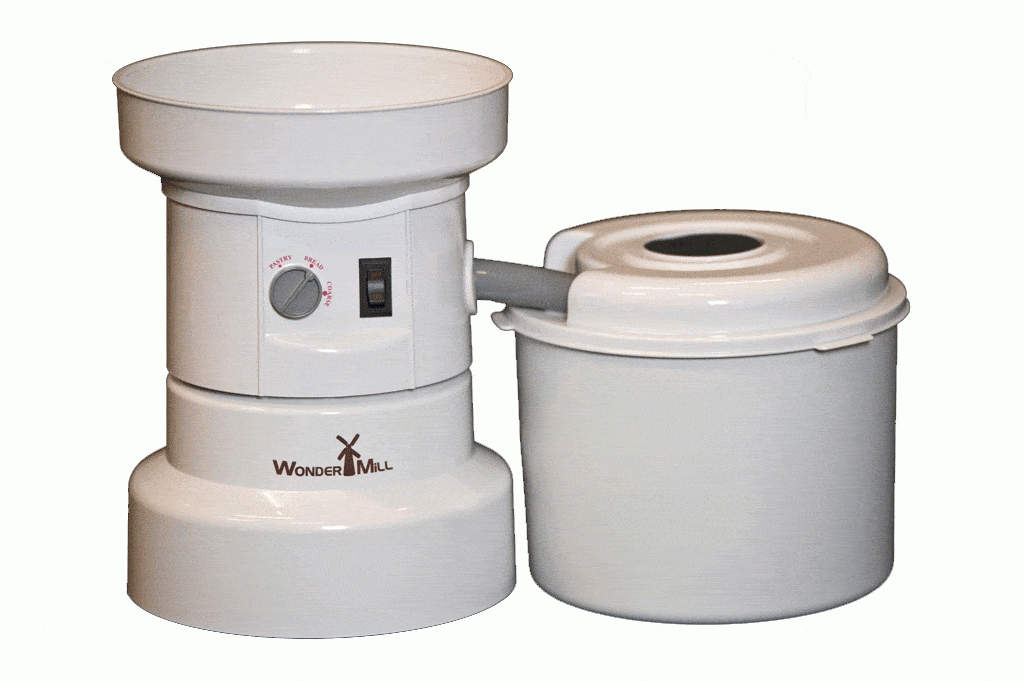
WonderMill: This one holds about 12 cups of grain and collects the flour in a separate container.
I bake a lot of bread. Like, a LOT. I’m grinding flour for multiple loaves at once, plus pizza dough, plus whatever baking projects my kids want to tackle on the weekend.
For me, the NutriMill’s larger capacity means I’m not constantly refilling. I can grind once and be done.
But if you’re baking one or two loaves at a time? The WonderMill capacity is more than enough.
Storage Space and Kitchen Footprint
The NutriMill has a bigger footprint because of that built-in flour bowl.
The WonderMill separates the motor unit from the flour canister. This makes it slightly easier to tuck away in smaller kitchens or store in a pantry.
How Easy Are These Grain Mills to Use?
Both machines are ridiculously simple:
- Add your grain to the hopper
- Adjust the texture setting (fine to coarse)
- Turn it on
- Collect your flour
That’s it. No learning curve. No complicated assembly.
The NutriMill keeps everything contained in its attached bowl, which I find tidy. The WonderMill’s separate container works great but requires one extra step to set up.
Neither one is difficult. You’ll figure both out in about 30 seconds.

Flour Texture and Grinding Quality
Both mills produce very fine flour. I mean very fine.
This matters when you’re baking:
- Whole wheat sandwich bread
- Sourdough bread
- Sourdough dinner rolls and sourdough biscuits
- Pancakes and waffles
- Muffins and quick breads
I’ve never struggled to get fine, soft flour from either machine. Both create flour that performs beautifully in yeast breads.
If you want coarser flour for a rustic loaf, both machines let you adjust the settings.
Noise Level: Let’s Be Honest
Both machines are really loud. I’m not going to sugarcoat this. When I grind flour, everyone in the house knows it.
The good news? They only run for a few minutes at a time. so it’s manageable.
What These Grain Mills Cannot Grind
Neither the NutriMill nor WonderMill can handle:
- Oily seeds (like flax in large quantities)
- Nuts
- Coffee beans
- Wet or moist grains
They’re designed specifically for dry grains. Stick to wheat berries, rye, oats, spelt, and similar grains.
If you try to grind oily stuff, you’ll gum up the mechanism. Don’t do it.

Real-Life Performance: What I’ve Learned Using Both Mills
When I grind flour at home, here’s what I need:
- Consistent texture every single time
- Speed (I’m not standing around for 10 minutes)
- Minimal mess
- Easy cleanup
Both mills deliver on all of these.
The NutriMill feels more self-contained. Everything happens in one unit, and cleanup is straightforward.
The WonderMill feels more modular. You can swap out the flour container, which some people prefer.
Here’s my take: If you grind large batches weekly (like I do), the NutriMill’s bigger bowl saves time. If you grind smaller amounts occasionally, the WonderMill works beautifully.
Which Grain Mill Is Best for Sourdough Bread?
I bake sourdough almost every week.
Both mills work perfectly for sourdough.
Fresh-milled flour ferments faster and produces better flavor. I’ve noticed this consistently with both machines.
The key is consistency, and both the NutriMill and WonderMill provide that.
Choose based on how much flour you need at once, not which machine makes “better” sourdough flour. They’re both excellent.
NutriMill vs WonderMill Price Comparison
Prices fluctuate depending on sales and retailers, but typically these mills are in a similar price range.
Both are investments. We’re talking a few hundred dollars either way.
Here’s what I recommend:
- Watch for seasonal sales (Black Friday, Amazon Prime Day)
- Check the warranty coverage
- Consider shipping costs
Since this is a long-term kitchen tool you’ll use for years, I focus more on daily usability than minor price differences.
Spending an extra $20 or $30 isn’t worth worrying about if one machine fits your needs better.
A Third Option: The KoMo Mill
Another grain mill many home bakers love is the KoMo Classic mill. I haven’t personally used one yet, but it often comes up in conversations with bakers who want something different from impact mills like NutriMill and WonderMill.
Here’s why a KoMo mill is worth considering:
- It uses stone burr grinding rather than high-speed impact.
Stone burrs crush the grain between stones, which many bakers say produces a richer, more flavorful flour. - It runs quieter than impact machines.
If noise is a concern in your kitchen, that can make a big difference. - The design is compact and attractive.
KoMo mills often look nicer on a countertop and take up less space than traditional impact mills. - The motor is usually built for long-lasting, consistent performance.
Stone mill grinders like KoMo are slower than impact mills. Some bakers prefer that slower grind and the texture it produces, especially for whole-grain baking.
I’m intrigued by KoMo because of that quieter operation and the compact design — not because the NutriMill or WonderMill are poor performers. After more than 20 years of impact milling in my own kitchen, I’m curious what a stone burr mill might add to my baking routine.
My Final Recommendation: Which Grain Mill Should You Buy?
Here’s my honest take after using both.
Choose the NutriMill if:
- You grind large batches of flour regularly
- You want the built-in flour collection bowl
- You bake multiple loaves at once
- You have counter space to keep it out
Choose the WonderMill if:
- You have limited storage space
- You prefer a slightly smaller, more compact unit
- You grind flour occasionally (not weekly)
- You like the modular design
Both make excellent flour that will improve your baking. Both are reliable machines. You genuinely can’t go wrong with either one.
Is Grinding Your Own Flour Actually Worth It?
Yes. Absolutely yes. I was skeptical at first and was worried that buying a grain mill felt like overkill.
But freshly milled flour has:
- Better flavor (noticeably better)
- More nutrients (the bran and germ stay intact)
- Better texture in finished bread
- Longer shelf life when you buy whole grains instead of flour
Plus, I’ve reduced my reliance on store-bought flour. I buy wheat berries in bulk, and I always have fresh flour when I need it.
If you already bake your own bread, adding a grain mill is the next logical step.
Frequently Asked Questions About NutriMill and WonderMill
Is NutriMill better than WonderMill?
Not necessarily. The NutriMill has a larger capacity, which I love. The WonderMill takes up less space, which some people prefer. Performance-wise, they’re comparable.
Can these grain mills grind corn?
Yes, they can grind dry dent corn. They’re not ideal for oily or wet grains, but dry corn works fine.
How long do these grain mills last?
With proper care, both brands are known for durability. Both come with solid warranties. I’ve had my NutriMill for years with zero issues.
Is freshly milled flour healthier than store-bought?
Yes. Fresh flour retains more nutrients because the bran and germ stay intact until you grind it. Store-bought whole wheat flour loses nutrients over time as it sits on the shelf.
Can I grind gluten-free grains in these mills?
Absolutely. Both mills handle rice, quinoa, buckwheat, and other gluten-free grains beautifully.











Thank you for this post. I’ve been considering purchasing a grain mill. We’ve been using an antique hand crank one that my husband found in his grandma’s basement. He rigged up a drill attachment for doing large quantities, but it’s difficult for me to use, so when I need a lot of flour I have him grind it for me. It does a beautiful job so I’m loath to give it up, but the convenience of dumping the grain in and pushing a button is certainly appealing.
Jessica, I’d love to have a hand crank mill – but only for extreme conditions like the downfall of society or prolonged power outages… 😉 Great for prepping, but not so practical for everyday use.
I own a Whisper Mill (looks just like a Wonder Mill- I believe they changed the name in the past few years). I like it quite well but seeing your side by side review I think I would go with the other one as the larger quanity and having only one item to store seems like it would fit our family and kitchen better. I appreciate knowing this information for the time when I will need to replace my grain grinder. I have had it for nearly 14 years now and I use it all the time- so it is lasting well.
We are considering a grain mill. It’s good to know that the differences are minor and that we’d probably be satisfied with either one of these.
No comparison with Magic Mill III?
I’m sorry, I don’t know what that mill is.
Check it out: http://67.131.250.107/~eshaw/magic.htm
I purchased one on Ebay a couple of months ago…did my homework and it is obviously heavy duty…and haven’t unfortunately had a chance to use it yet. 🙂
The Magic Mill III has been discontinued and is no longer available.
I inherited a Magic Mill III and I think there is a very good reason they were discontinued. Perhaps mine was just very poorly taken care of, but it is REALLY loud (louder than both of the other grain mills my mom has had), is temperamental, and a pain in the bum to open and clean. Since it is discontinued, it can be complicated &/or expensive to get filters and other parts for it. However, as long as it works for you, there is probably no reason to replace it. It does seem to grind a little hot, so if that matters to you, then you might wanna chill/freeze the grain before grinding it. Anyway, hope that helps. 🙂 Happy grinding!
I am still on the fence on which one to buy. Wondermill or Nutrimill
Someone had listed a Nutrimill on KSL.COM and went to pick up.
The seller powered it on for me, and it turned on then smoked then didn’t turn on again.
Said it was new in box and looked that way, but machine motor was gone.
Does one seem like a better motor to anyone or built better?
I had a Nutrill that was thrown out of the back of a truck at 65 mph and still worked just fine for many years. I’m not worried about the motor in my Nutrimill at all; and for that matter, I’m not worried about the motor in the Wondermill either. How long had the seller had it? They come with a good warranty – I can’t imagine that a Nutrimill that had never been used would just smoke unless there was some sort of defect. I think if you bought either mill and had that problem, the company would replace or repair them. 🙂 They both seem very well built, but like I’ve said here, I prefer my Nutrimill. Any more questions? 🙂 Good luck!
Hi. I came across your post, but cannot see how this compares to the wondermill. There is only the one page, and it is the nutrilmill. There is no arrow for next page, just related posts. I would really like to see the whole review and not just the first part. Am I missing something?
Any information that you may be able to provide would be greatly appreciated.
Thank you
Hi Lisa – Oh how frustrating! I’m sorry. I had a massive blog break a while back and I guess this is another victim. Looks like I will have to redo the post. Basically, the wondermill is smaller, grinds less flour in one setting. I prefer my Nutrimill, honestly, since I bake bread in 5 loaf batches and need a lot of flour at once.. But it’s also larger and needs more space to store. They’re not all that different. 🙂
I am also trying to decide between the two mills. I will mainly grind wheT but would like to grind a good bit of popcorn. Does the Nutrimill have a coarser setting or about the same?
I grind popcorn mostly in my Nutrimill and I like how it comes out. You can make it grind it coarser or finer depending on your needs. 🙂