Comté Cheese: How a Co-op of Small Farms Makes a Great Cheese

on Oct 18, 2026
This post may contain affiliate links. Please read our disclosure policy.
When Comté invited me to France, I said yes before I really knew what I was saying yes to. A cheese trip sounded fun. I like cheese and I like France. But I had no idea what to expect from four days in the Jura, a mountain region in eastern France I knew almost nothing about.
Disclosure: My travel to the French Jura was sponsored by Comté. The opinions in this post are my own.

I came home with more than a better understanding of Comté cheese. Not only did I learn how cheese is made, but I realized how connected the farmer, the cheesemaker, and the person buying the cheese really are. The same lesson applies to any food, farm, or town: we all do better when the people who grow, make, and buy look out for each other.
Comté Cheese Quick Overview
- Comté is a hard, cooked, pressed cheese from the Jura Mountains in eastern France.
- A cooperative of about 2,400 farms, 138 village dairies, and 15 aging cellars makes it.
- It’s an AOP cheese, which means a legal protection ties the name to one region and a set of traditional rules. The rules protect the cheese’s quality and the small farms that make it.
- Every dairy only takes milk from farms within 25 km, which keeps the cheese small-scale.
- The farmers’ milk price follows the price the cheese sells for.
- A hot, dry summer across Europe has farmers and cheesemakers worried.
- Gruyère is the closest substitute, but you can find real Comté at Trader Joe’s , Whole Foods, and specialty cheese shops nationwide and online.
What Is Comté Cheese?
Comté is made in wheels that weigh about 40 kilos, around 88 pounds. One wheel takes about 400 liters of milk, or roughly 105 gallons. The milk comes from Montbéliarde cows, or French Simmental cows, and it’s used raw. Once the cheese is made, it’s aged for at least four months.
About 90% of Comté is sold in France, and only around 2% comes to the USA. So most of us don’t see it as often as we’d like. After this trip, I want to find all the local places to buy my new favorite cheese!
A Cheesemonger Who Knows His Favorite Age
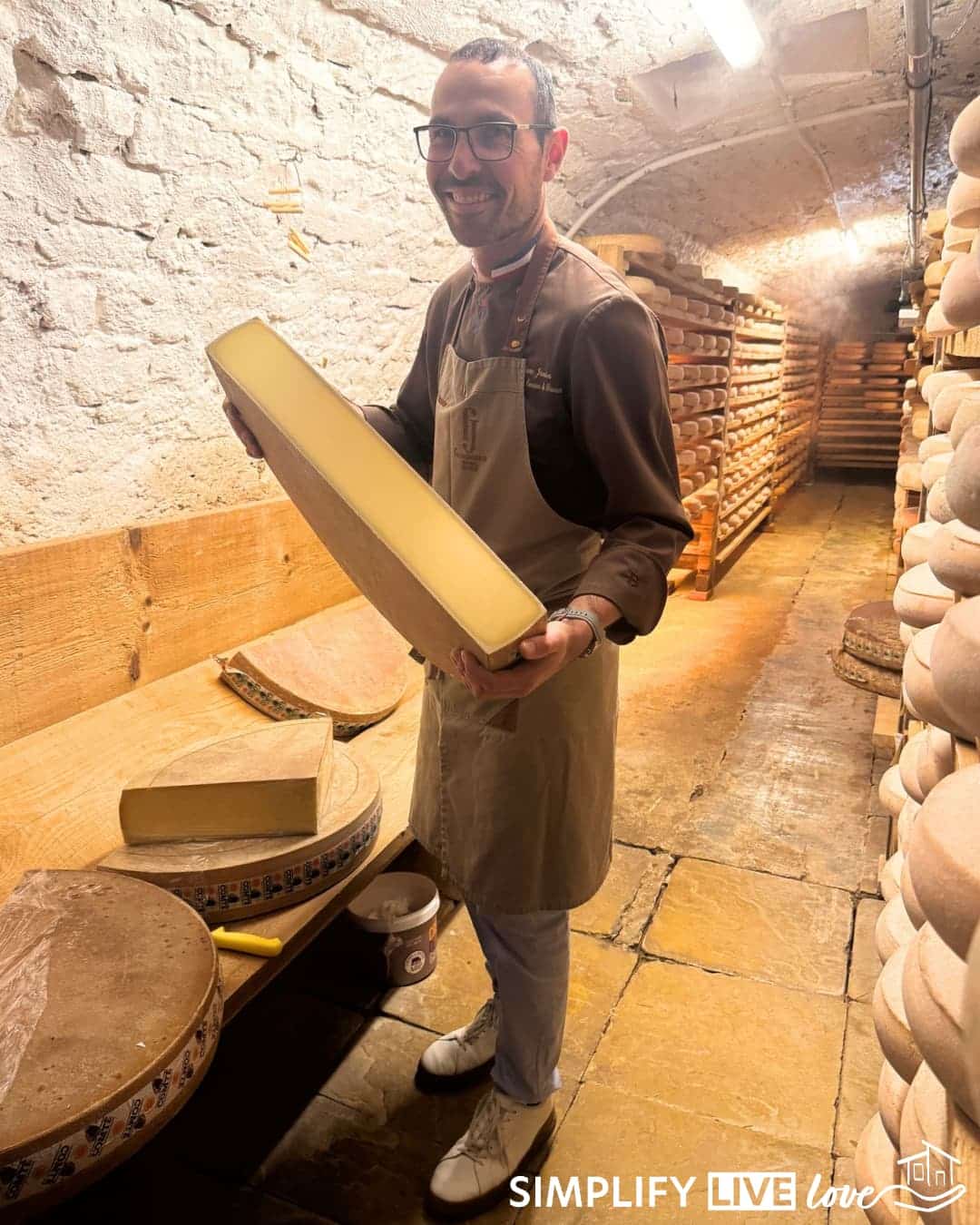
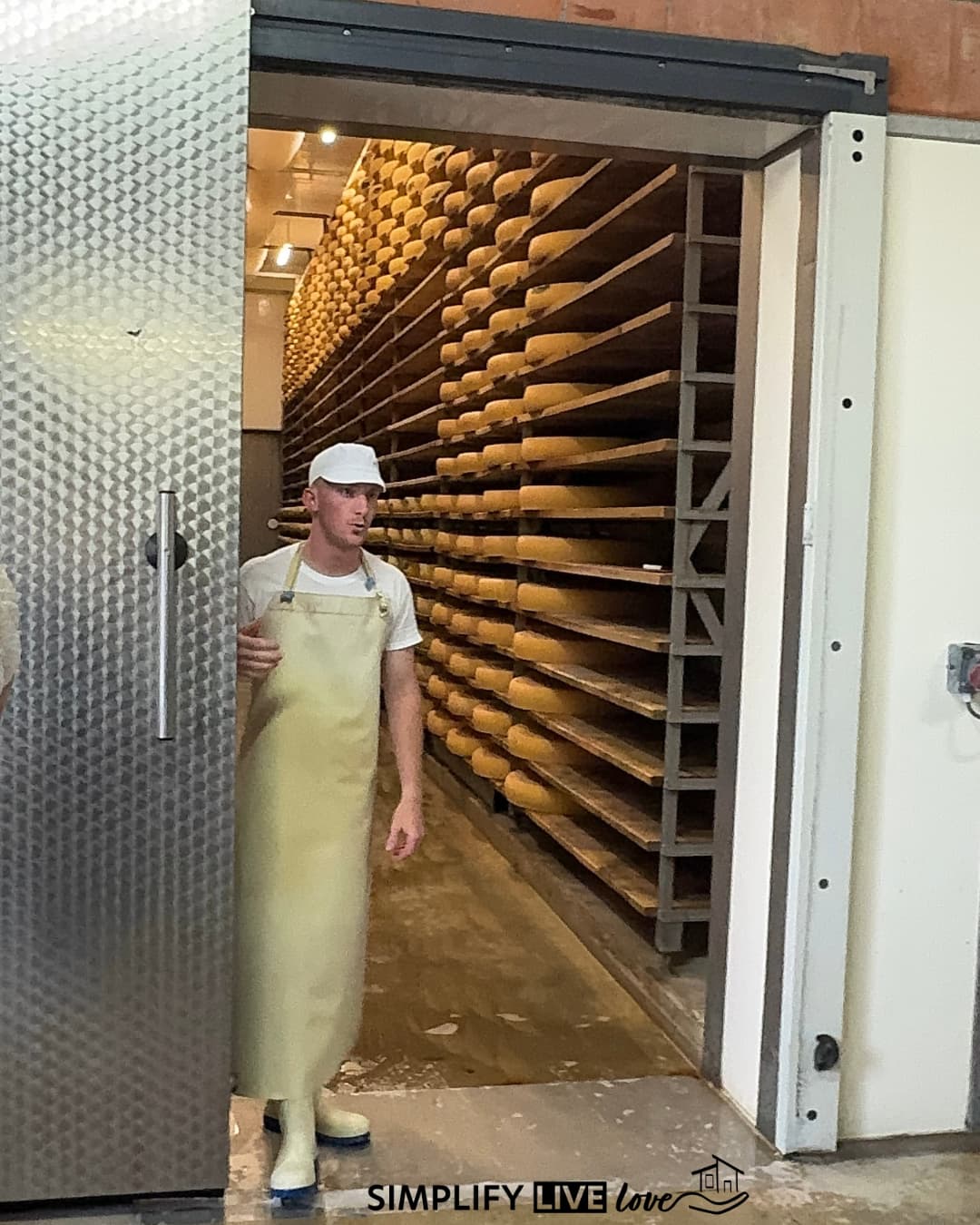
Our lesson on Comté cheese started at the end of the process, in the town of Champagnole at Fromagerie Janin. Marc Janin, the owner of the cheese shop we visited, holds the title of Meilleur Ouvrier de France (MOF), or “Best Craftsman in France,” one of the highest honors in French craftsmanship. Craftspeople in trades from cooking to cheesemongering compete in a national competition. The winners earn the title for life and the right to wear a jacket with a blue, white, and red collar.
Marc gave us a great introduction to Comté cheese by showing us his cheese cellars and giving us our first bites. Here’s what he told us:
- The best Comté is between 14 and 20 months old. That’s when the aromas and the creamy texture are at their peak.
- His favorite is 17 months. Older than that and the texture gets harder.
- He eats young Comté for breakfast and saves the aged wheels for an aperitif.
- Once a wheel is cut, eat it within five weeks, because the flavor fades after that.
There are more kinds of Comté than I expected, and age is only one part of the story.

The Farm With 30 Cows and a Goat Story
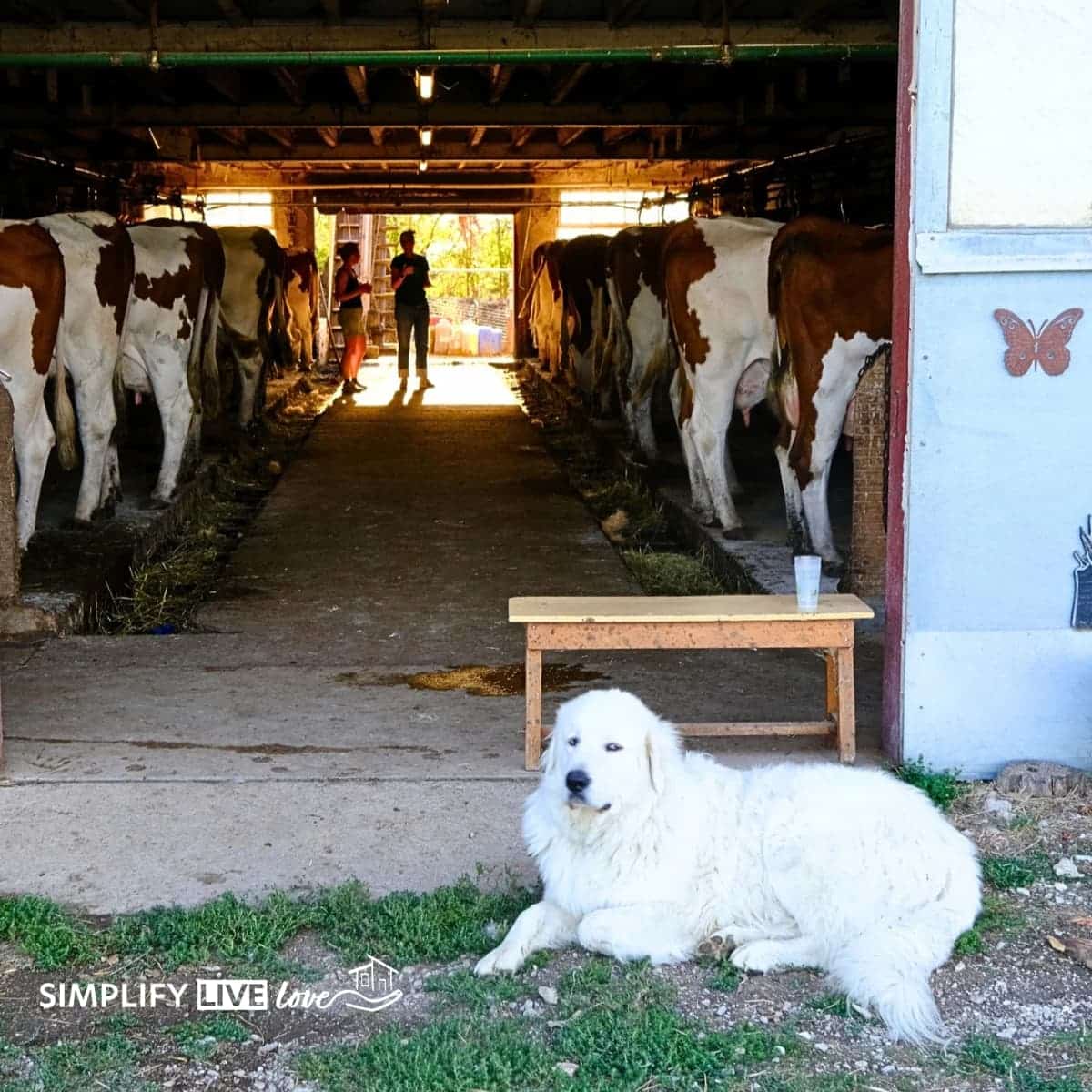
The best day of the trip was on a small farm in Vernierfontaine. Nicolas and Juliette milk 30 Montbéliarde cows. Their border collie is named Naso, and their Great Pyrenees is named Donut. We have Great Pyrs at home, so meeting Donut was a fun find.
Nicolas didn’t grow up planning to be a dairy farmer. He was looking for hay for his three lawn-mowing goats and ended up buying the farm. He started working alongside the previous owner, Jérôme in 2019, to learn the business. Three years later his wife joined him.
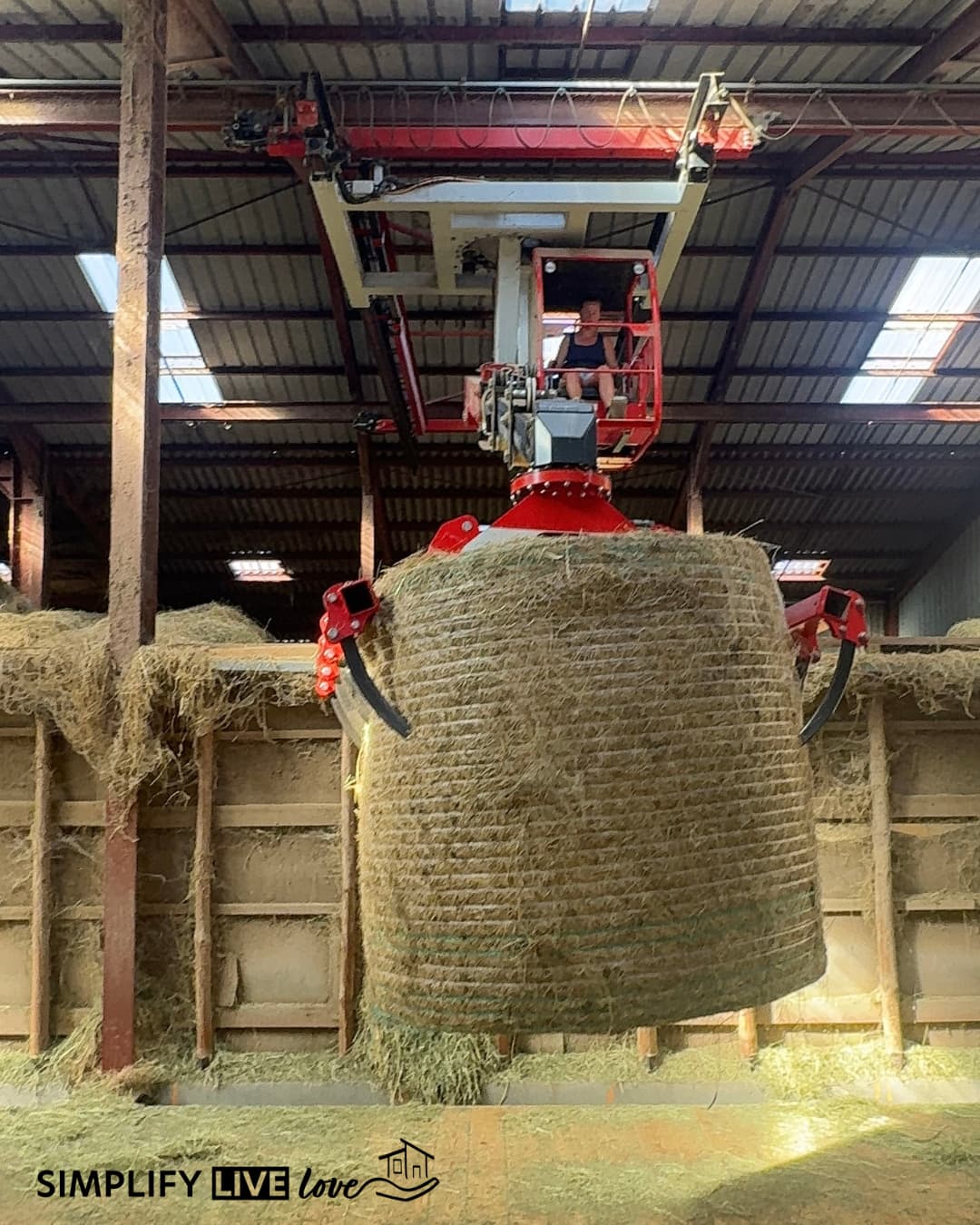
They chose Comté because the way the cheese is made matched what they wanted for their animals and their life. A small herd can make a good living when the milk goes into Comté.
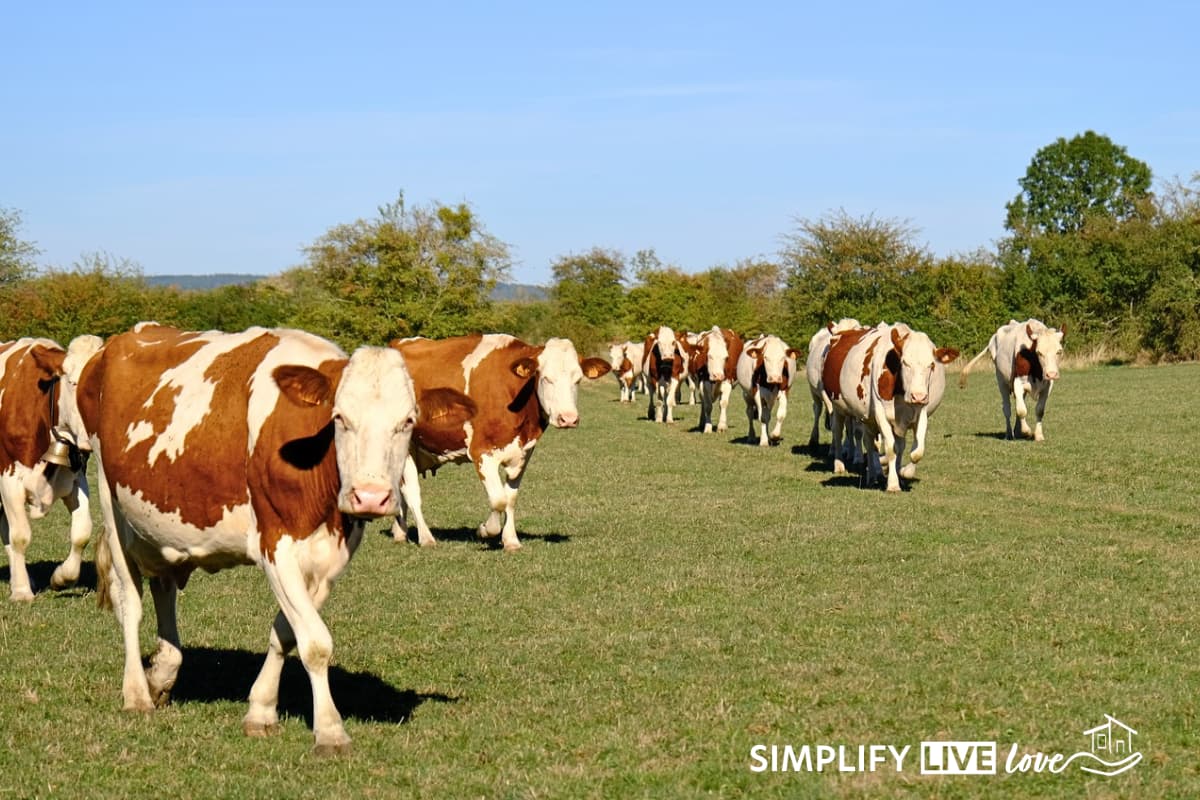
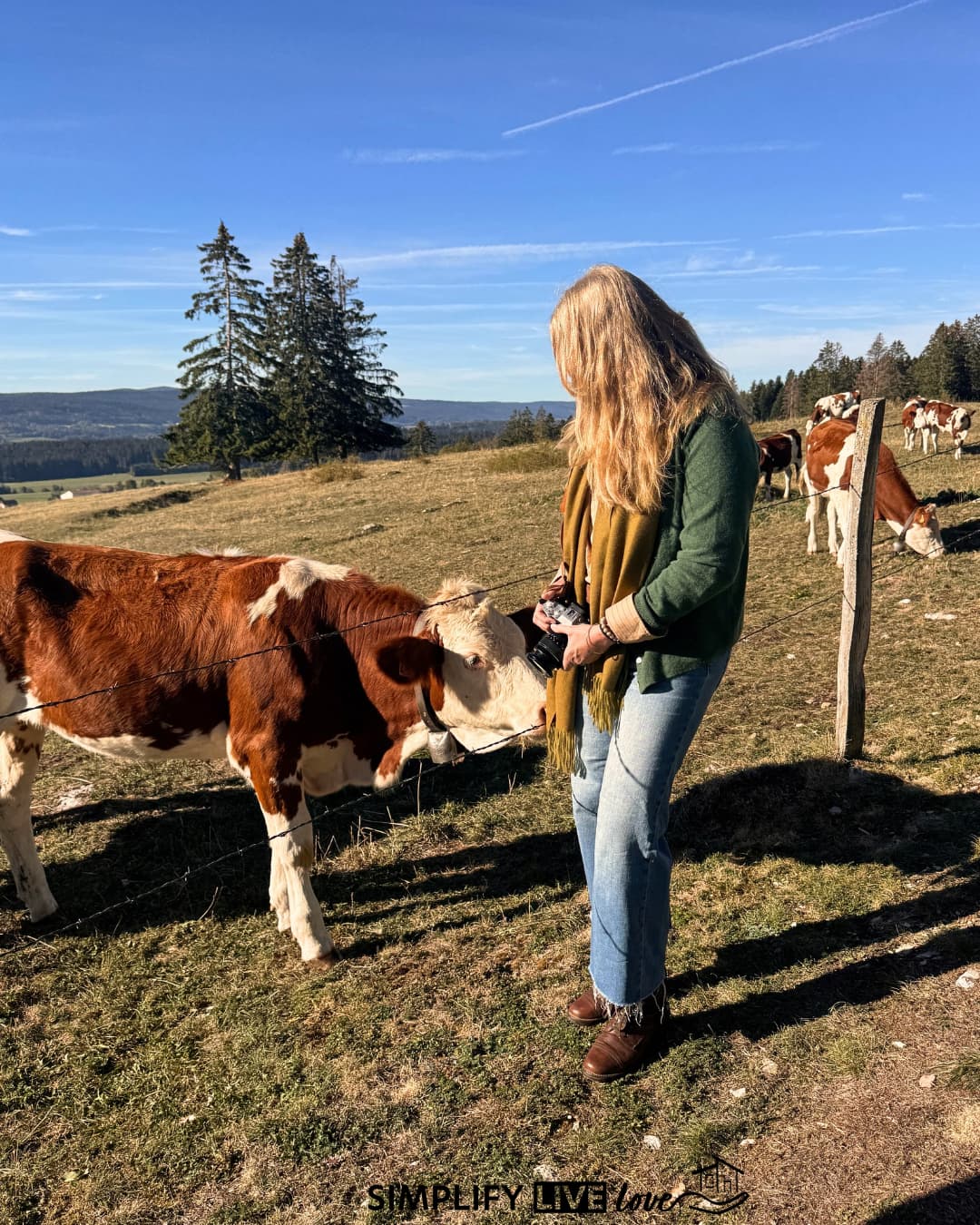
Walking the pasture and watching the milking was amazing. The cows are so well behaved. They know exactly where to go and what to do, and every cow knows which spot in the milking parlor is hers.
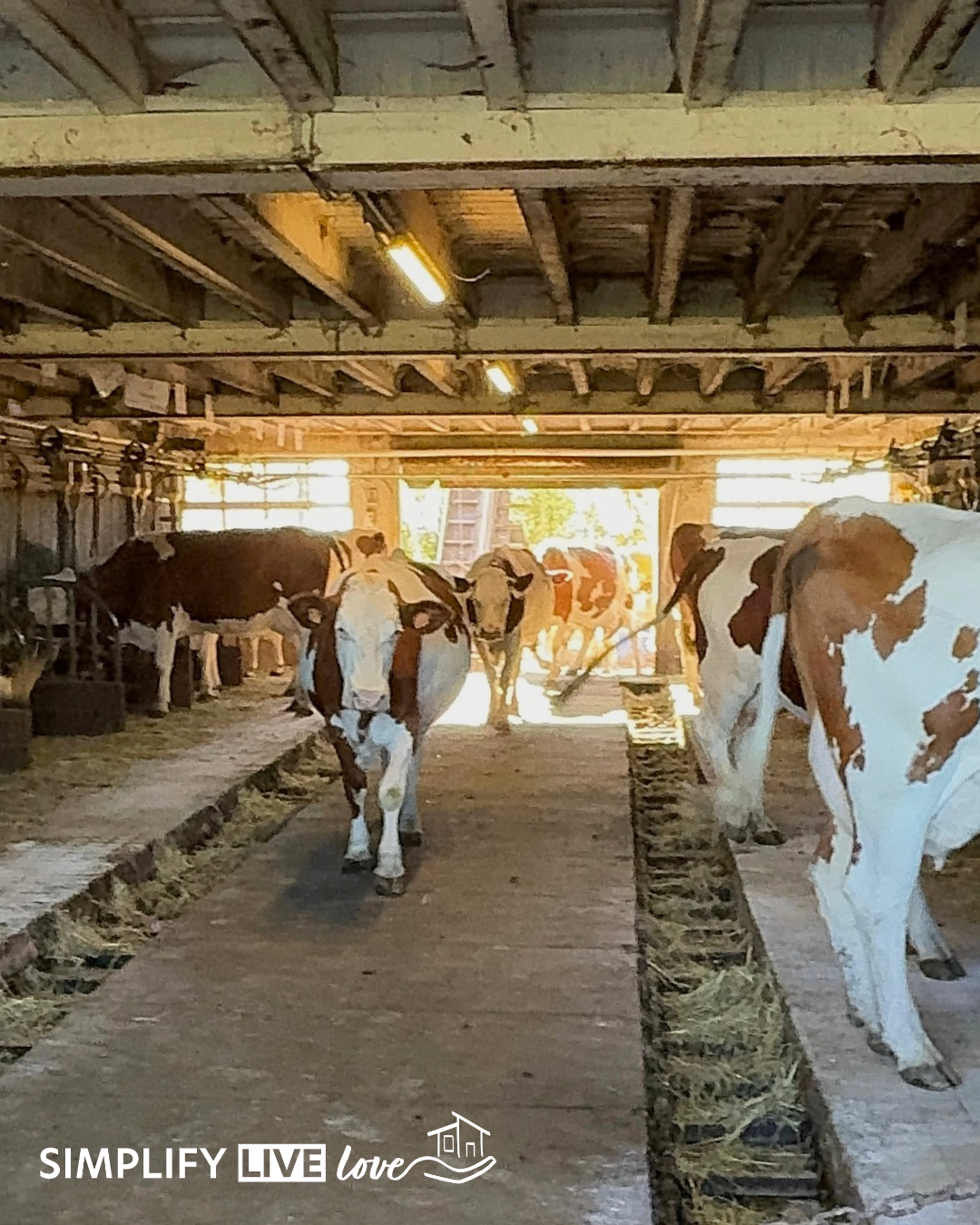
Each cow’s name is printed on a sign over the spot she headed for after she came in the milking parlor. It is almost like the cows can read. If you’ve ever tried to move animals anywhere, you know how hard it can be. The cows just calmly walked right to the spot with no help from Nicolas or Juliette.
How the Comté Cooperative Works
The cooperative part of the Comté process was the most interesting part of the trip. Comté isn’t made by one company. It’s made by a cooperative of farms, dairies, and aging cellars, and it works because everyone involved depends on everyone else.
Farms like Nicolas and Juliette’s bring their milk to a village dairy. Every farm has to be within 25 km of the dairy, and that circle keeps the cheese local and artisan. Only 18 farms bring milk to the Vernierfontaine fruitière (dairy) so everyone really knows everyone.
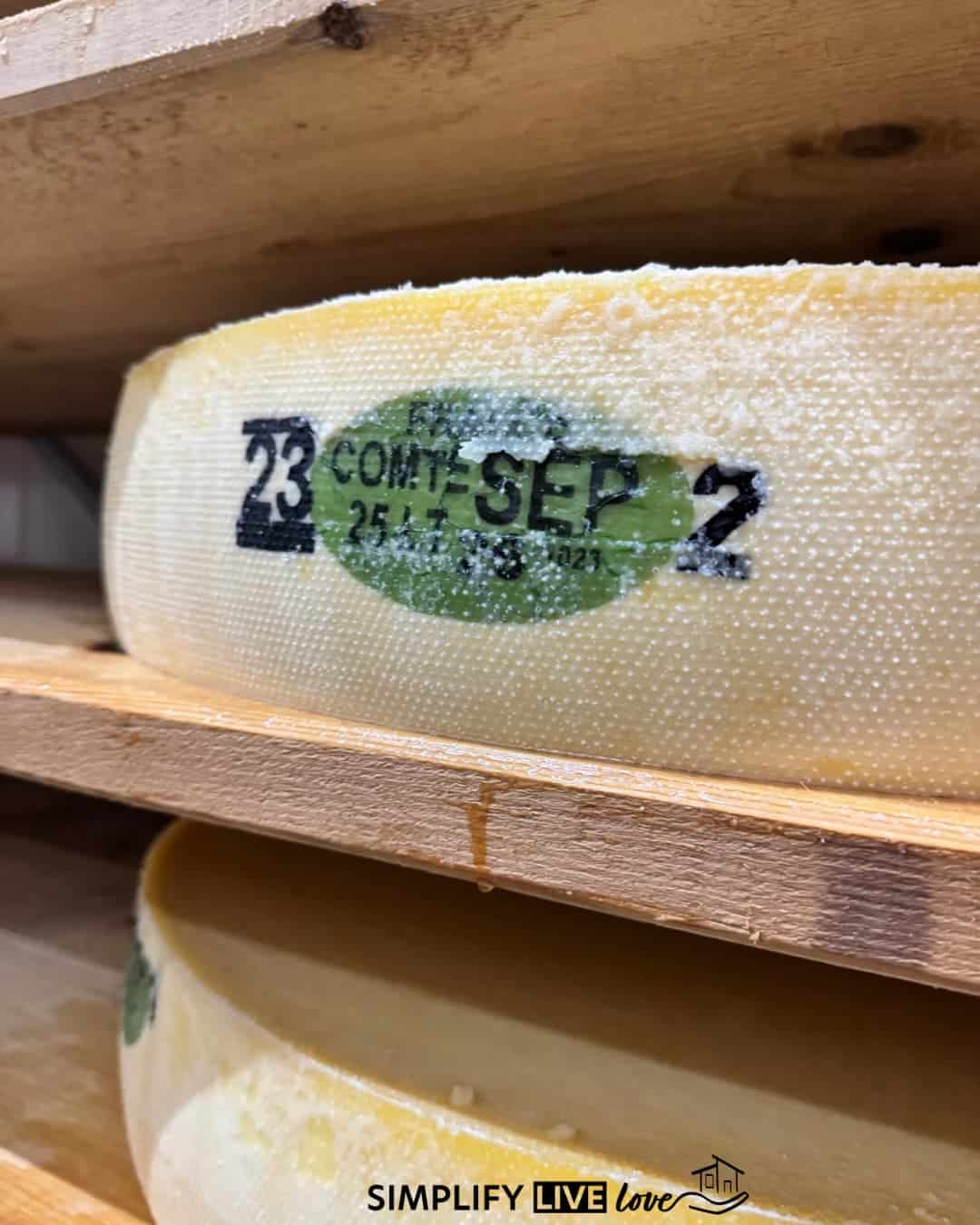
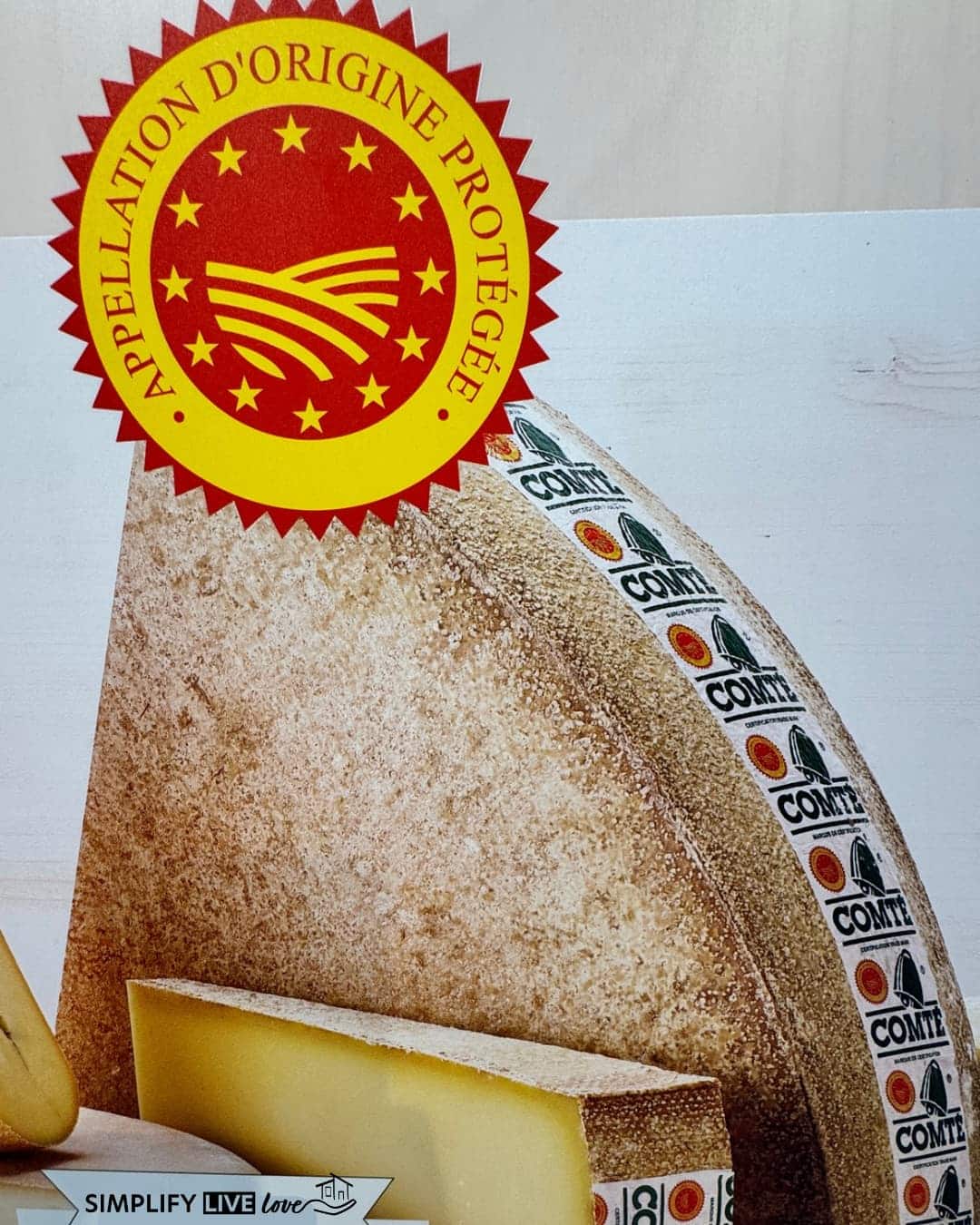
Then there’s the green tag. Every wheel of Comté gets a green plaque pressed into its rind when it’s made. It shows that the cheese is real Comté, along with the day, month, and year it was made and a code for the dairy that made it. The Comté organization is the only one that can hand them out, so it’s also how they keep track of how much cheese is being made.
Each dairy only receives a certain number of green tags, based on its past production. Buying more is very expensive, so it doesn’t make sense for farmers to push for more milk production. That’s one way Comté keeps its traditional ways.
Success Depends on Everyone
The farmers’ milk price is linked to the price the cheese sells for. If the cheese does well, so do they. The Comté organization told us they are trying to preserve the small family farm way of life. Because the cheese is tied directly to consumers instead of the world market, it gives farmers stability and helps them avoid crises.
What Does AOP Mean for Comté Cheese?
You’ll see the letters AOP in a red and yellow circle on some European food. It stands for Appellation d’Origine Protégée, or Protected Designation of Origin. In plain terms, it’s a legal promise that a product comes from a specific place and is made a specific way. Champagne works the same way. So does Parmigiano-Reggiano.
Comté has been protected in France since 1958, and it became an AOP under European Union rules in 1996. That means nobody can sell a cheese called Comté unless it follows the rules and works within the coop. Among the main specifications:
- It’s made only in a defined area of the Jura Mountains in eastern France.
- It’s made from raw milk from Montbéliarde or French Simmental cows.
- The feed comes from the region, and the cows spend time on pasture.
- The milk comes from farms within 25 km of the dairy that makes it.
- It’s aged for at least four months.
- Tasters score each wheel out of 20, and cheese that scores between 15-20 are given a green Comté band (which you commonly see in the U.S.). Wheels that score 12-14 points are given a brown band. Wheels that score less than 12 are excluded.
- That last rule connects to what we saw later at the aging cellar, where professional tasters sample hundreds of pieces a day.
For farmers, AOP is what protects the whole system. Nobody can make a cheaper version, call it Comté, and undercut them. For us as shoppers, it means the name on the label tells you where the cheese came from and how it was made.
How Is Comté Cheese Made?
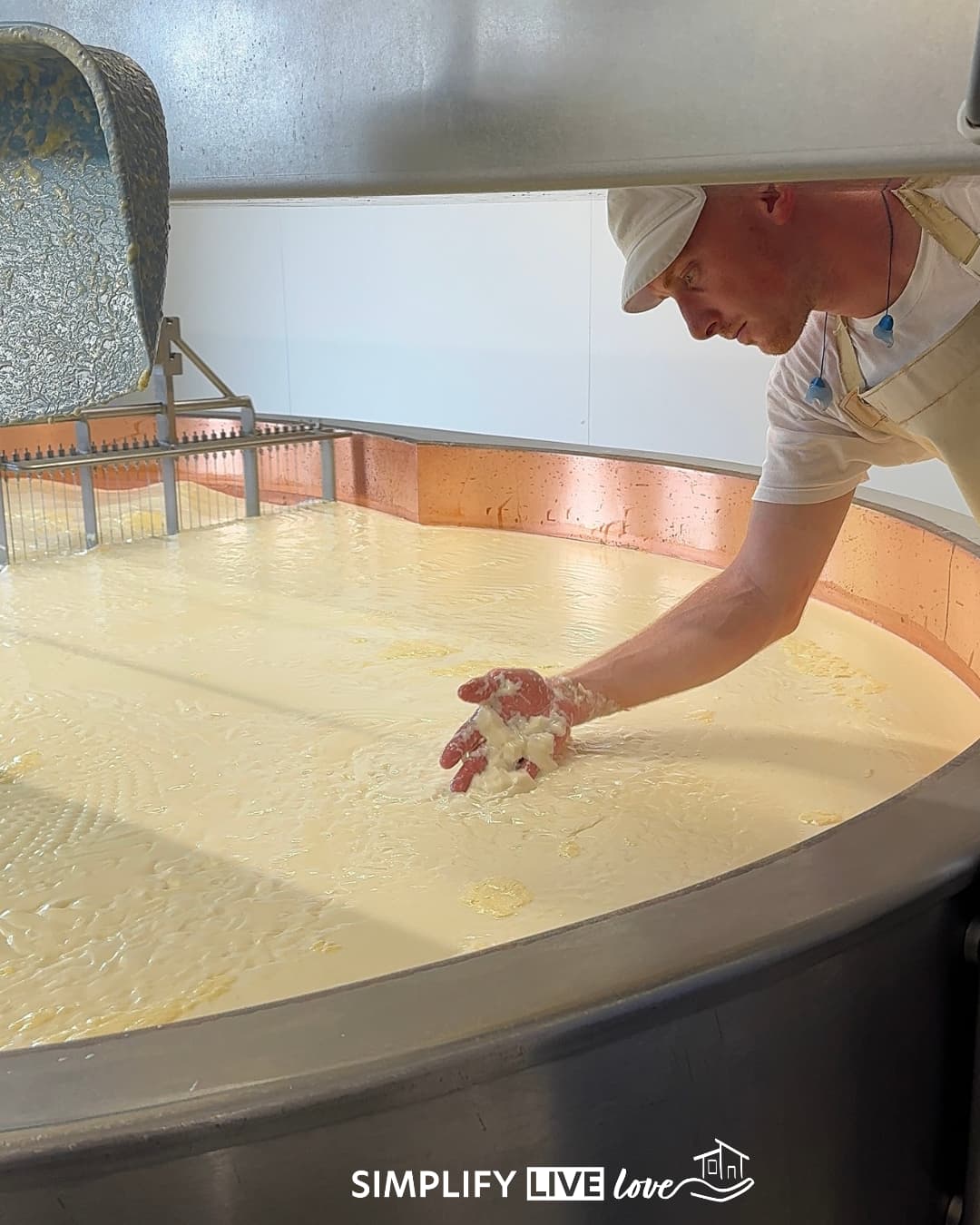
We saw it happen at the village dairy that serves Nicolas and Juliette’s farm. The milk arrives and has to stay at 56°F, which helps protect the microorganisms in it. Cheesemaker Antoine Cattin walked us through the steps:
- The milk thickens into something like yogurt, which takes about 40 minutes.
- An experienced cheesemaker breaks the thickened milk into small curds. One vat holds 4,800 liters of milk and makes 8 to 12 wheels.
- The whey gets pumped out. The dairy sells some of it to be turned into protein powder, and they use cold water to cool the hot whey. The water that warms up in the process is then used to clean the vats. Some of the whey is kept to make butter and cream.
- Next, the curds are pressed into wheels, and each wheel gets its green tag.
- The wheels rest in the dairy’s cellar for about two months. A robot salts them, flips them, and moves them around. Some go on to an aging cellar, and some stay for the dairy’s own finishing.

Aging Cheese in Fort Saint-Antoine
Some wheels leave the village dairy for an aging cellar, and Fort Saint-Antoine is one of those cellars. The village of Saint-Antoine handed over this fort for one French franc, and it turned out to have almost perfect conditions for aging cheese: 6-9°C (46°F) and 90% humidity.
In 1966 a cheese pioneer arrived at the fort with 2,000 wheels of Comté. Back then, producers wanted to age cheese faster, at 15°C (59°F). Quicker aging meant that the Comté had bigger holes because the bacteria multiplied more quickly. However, at Fort Saint-Antoine, the cheese was aged colder and slower, resulting in a smooth and creamy cheese with few holes. This aging process has become today’s standard.
Today the fort holds about 100,000 wheels, and this year is its 60th anniversary. Because fermentation gives off heat, the fort now has to be cooled to stay at 8°C. Five professional tasters at the fort try 200 to 300 pieces of cheese every day. Seeing this in person was absolutely mind boggling!

Weather’s Impact on Cheese Making
You might know that Europe had a very hot summer this year – but you might not think about what that means for farmers and cheesemakers. Dry weather means less fresh grass for the cows. It also means less hay for the winter. Less grass means cows produce less milk. You understand the cycle, right? If the drought continues, they’re not sure how they’ll manage without rain. The farmers and the cheesemakers are concerned.
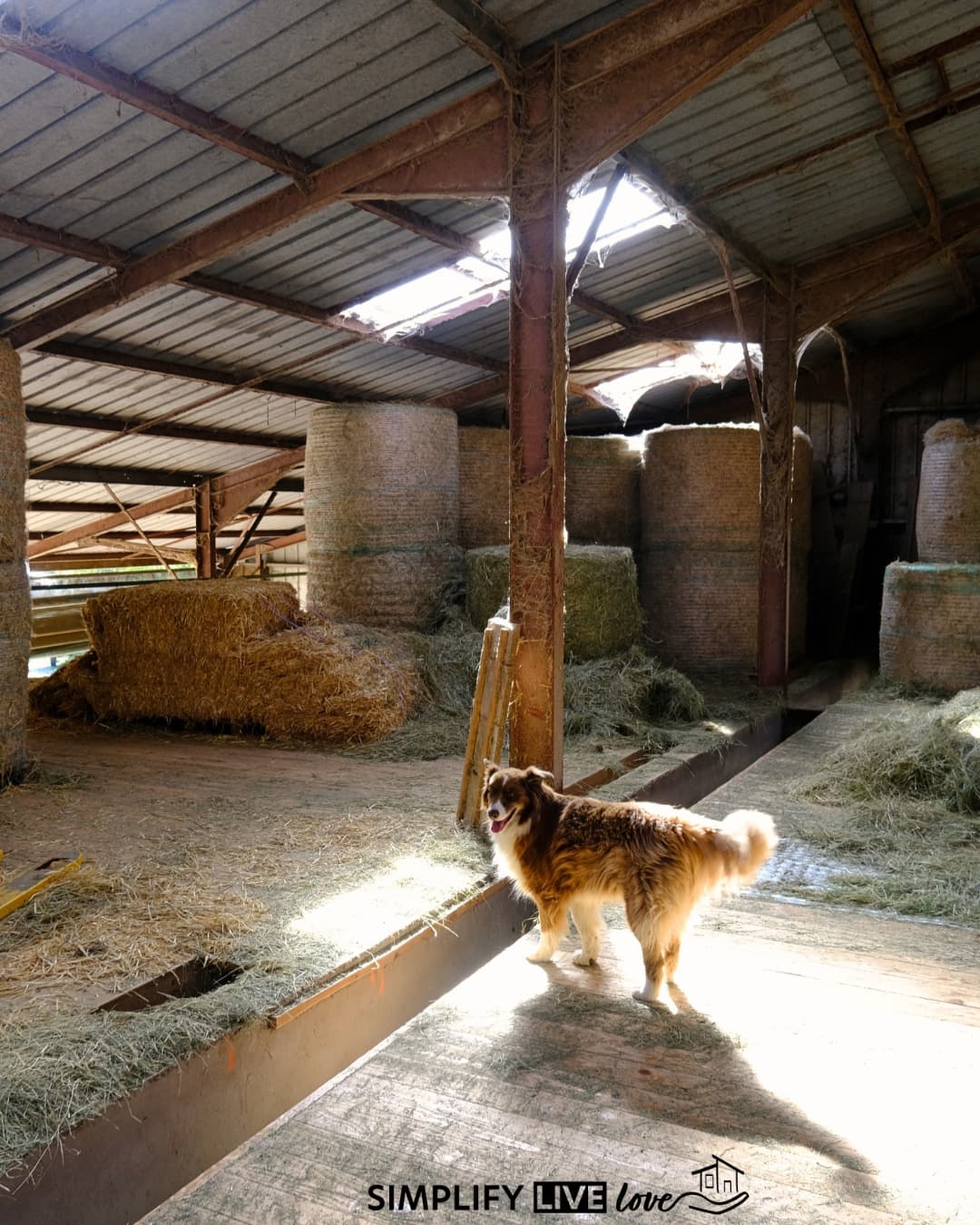
I care about climate change, but sitting in a pasture with someone whose whole livelihood depends on rainfall made it a lot more real than a headline does. These aren’t people who want to complain about the weather. They’re people who want to do their part in making cheese. They told us plainly that the changing weather worries them.
What It Means for Us in the USA
I didn’t expect a French cheese trip to make me think about my own backyard, but it did.
I live on a five acres hobby farm. So I know a little about chores that don’t care how tired you are, and about animals that depend on you. So I understood what Nicolas and Juliette take on, even if my version is much smaller.
What I love most about Comté is that nobody does it alone. The farmer needs the dairy. The dairy needs good milk. The cellar needs a wheel worth aging. The shop needs people who want to buy their cheese. Everyone works together toward something delicious, and everyone makes a living from it. That’s the way life should be, don’t you think?
A few ways to bring a little of that home:
- Buy from farmers and producers you can actually talk to.
- Ask where your food comes from, even at the cheese counter.
- Pay a fair price for good food, and waste less of it.
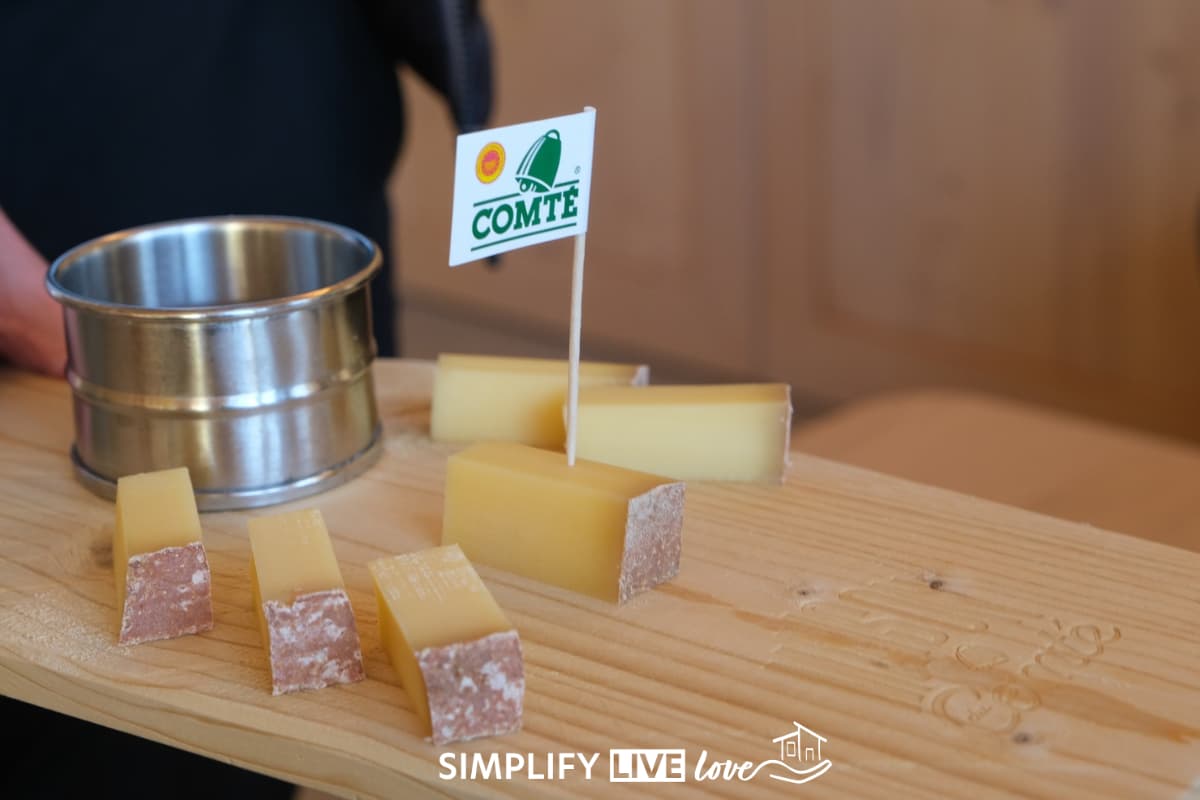
What Does Comté Taste Like?
Comté comes in more than a couple of types. We were told there are four, sorted by age from young to old, and texture matters as much as flavor. The cheese gets harder as it ages.
Age is only part of the picture. I photographed a Comté flavor wheel on the trip, and it shows how many different aromas can turn up in one cheese. It sorts them into six families, with a small “other” group on the side. Here are a few examples from each:
- Milky: fresh milk, fresh butter, cream, yogurt, white chocolate
- Fruity: nuts like hazelnut, walnut, and cashew, plus orange, apricot, dried pineapple, and wildflower honey
- Roasted: fresh bread crust, brioche, caramel, milky coffee, roasted almonds, dark chocolate
- Vegetal: hay, fresh grass, celery, leek, mushroom, earth
- Animal: leather, wet wool, a barn, cows being milked
- Spicy: vanilla, pepper, nutmeg, anise, curry
The wheel lists dozens of aromas in all, and no single wheel will have every single one.
Best Comté Cheese Substitutes
If you can’t find Comté, these are the closest options:
- Gruyère: The closest match in flavor and texture. Use it 1:1.
- Emmental: Milder and sweeter, with a great melt. A good fondue choice.
- Beaufort: Buttery and slightly floral. Works well in gratins and sauces.
- Aged cheddar: Not a traditional match, but it has a similar nutty sharpness.
- Gouda: Milder and a little sweeter. Melts well in casseroles and quiche.

How to Cook With Comté
Comté melts smoothly and holds its flavor under heat. It’s good in:
- Gratins and baked casseroles
- Quiche and savory tarts
- Fondue, usually blended with other mountain cheeses
- Grilled cheese and sandwiches
- Cheese boards, with fruit, nuts, or a Jura white wine
The Comté fondue we had in Malbuisson was so delicious, I hope to be able to replicate it at home and share a recipe with you!
How to Buy and Store Comté
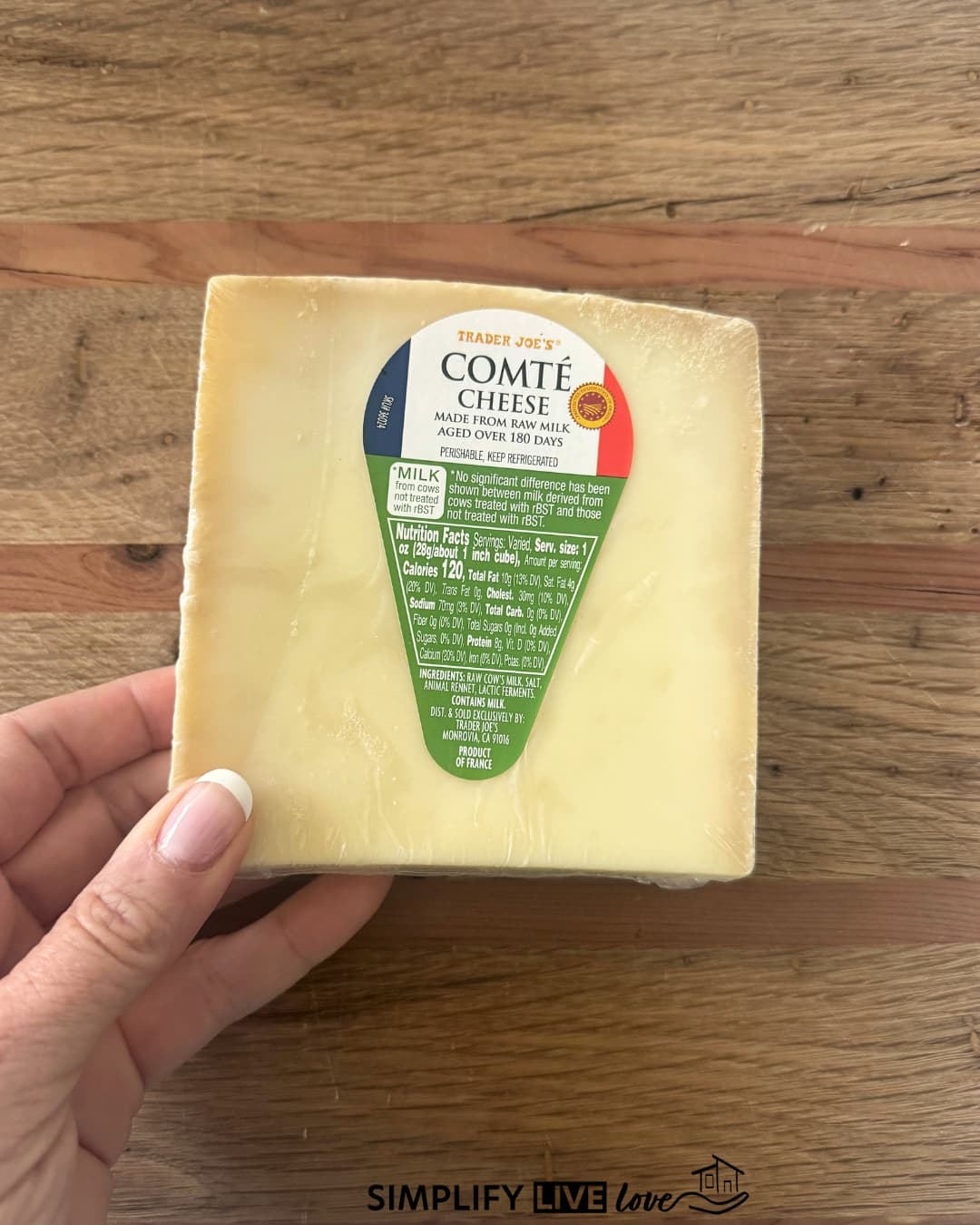
- Trader Joe’s is the easiest place for me to find it. Cheese shops and grocery stores with a cheese counter also carry it.
- Look for the name Comté and the green band on the rind. It’s a protected name, so it really does come from this region.
- Ask for the age. If you can, taste a young piece and an older piece side by side.
- Once a wheel is cut, plan to eat it within five weeks. The flavor fades after that.
- Wrap it in cheese paper or parchment and keep it in the fridge.
Pin this now to find it later
Pin ItFrequently Asked Questions about Comté cheese
Comté is a hard, cooked, pressed cheese made from raw cow’s milk in the Jura Mountains of France. A cooperative of small farms, village dairies, and aging cellars makes it.
It depends many factors, including its age. Comté comes in several types, sorted from young to summer to winter. Comté also has a flavor wheel which groups its aromas into six families: milky, fruity, roasted, vegetal, animal, and spicy.
No, but they’re related. Both are mountain cheeses made from cow’s milk. Comté is made only in the Jura region of France, while Gruyère is Swiss. Gruyère is the most common substitute.
Emmental melts smoothly and works well. Many fondue recipes blend Comté with Emmental or Gruyère.
No. Comté is made from raw milk.
At least four months. Many wheels age much longer, and the cheesemonger I met says the best Comté is between 14 and 20 months old.
It stands for Appellation d’Origine Protégée, or Protected Designation of Origin. It means the cheese is made in a specific region by specific rules.
Trader Joe’s sells it, so that’s an easy place to start if you don’t have any good cheese shops like me. Cheese shops and grocery stores with a good cheese counter are your other best bets. Check that the label says Comté and ask the cheesemonger how old it is.
Related Reading
Want to see the region for yourself? Stay tuned for my Comté Cheese Road Trip Through the French Jura for the route, where to eat, and what to book.
For more from the trip, keep an eye out for guides to Annecy and Hamburg, as well as some delicious Comté recipes!
Ready to travel? Use these helpful links to book your stay!
- Book your plane ticket with Expedia or Kayak
- Find a reasonably priced rental car or an RVShare rental for the perfect road trip
- Get your Harvest Hosts membership so you can camp at farms, wineries, breweries and more!
- We love using Hotels.com or Vrbo for the perfect home away from home
- Save on tickets to attractions, sightseeing tours, and more with TripAdvisor, CityPASS, Big Bus Tours, and Viator
- Don’t leave home without travel insurance to protect your trip!
- Check out our favorite 21 Time and Money Saving Travel Apps
- Get a National Park Pass to keep or gift